
What Unschooling Taught Me/Us About Grief
A weekly series about grief ignorance as a barrier to liberation work at home.
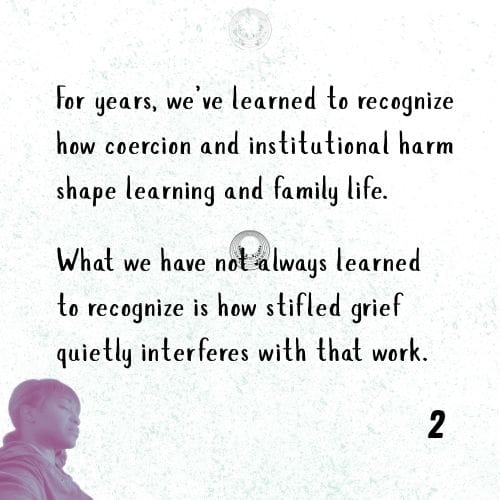
Unschooling taught me how to trust learning long before I understood what grief was asking of me.
For years, I kept those two worlds separate. Unschooling lived in the realm of parenting, liberation, and self-directed education. Grief lived in the realm of death, endings, and loss. They felt like different languages, different doors altogether.
And then, slowly, I started to recognize the pattern.
Unschooling didn’t just teach me how to follow my children’s curiosity. It taught me how to live without outsourcing my authority. It taught me how to move without a syllabus. It taught me how to stay present inside uncertainty. It taught me how to listen for what was alive instead of clinging to what was familiar.
Grief asks for all of that.
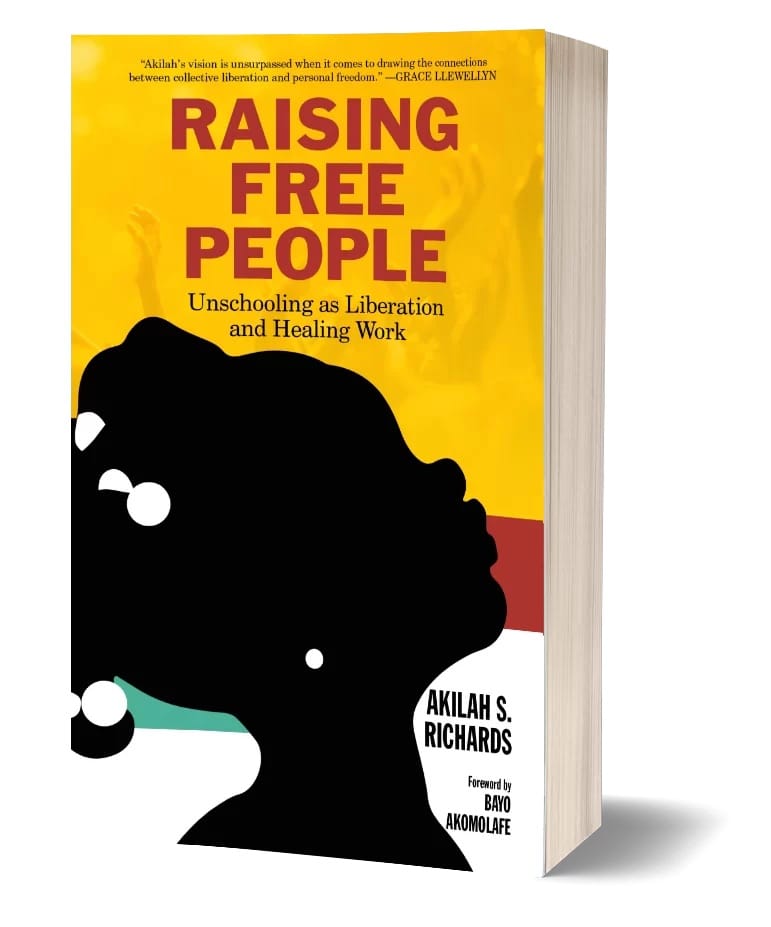
If you’ve been around my work for a while, especially if you read Raising Free People: Unschooling as Liberation and Healing Work, if you listened to Fare of the Free Child, if you’ve lived some version of this life, you already know.
You know that unschooling reaches far beyond education. You know it’s a way of relating. You know it’s a way of making choices, and a way of moving through the world without waiting for permission.
What I want to talk about in this series is the grief that lives inside that choice.
Because unschooling carries its own losses and its own grief.
There is the grief of releasing expectations about what family life was supposed to look like, alongside the grief of stepping away from systems that once provided structure and a sense of belonging. There is the grief of becoming harder to explain, of outgrowing people you love, of raising children without the familiar scaffolding of sameness, and of slowly realizing how much of your life had been built on external validation.
There is also the grief of articulation. When your life does not translate easily. When your choices seem to require endless explanations. When your way of being asks for more language than most people are willing to offer.
In a world where legibility carries social and economic weight, unschoolers often find themselves living at the edges of comprehension, and that displacement carries its own quiet losses. Most of us were never taught how to tend those losses by staying with them long enough to learn what they are asking of us.
And yet, unschooling prepared us anyway.
It taught us how to trust growth that does not move in straight lines. Unschooling and deschooling are constantly signaling us toward honoring capacity rather than compliance, along with how to loosen our grip on control, and how to live without (a sense of) guarantees.
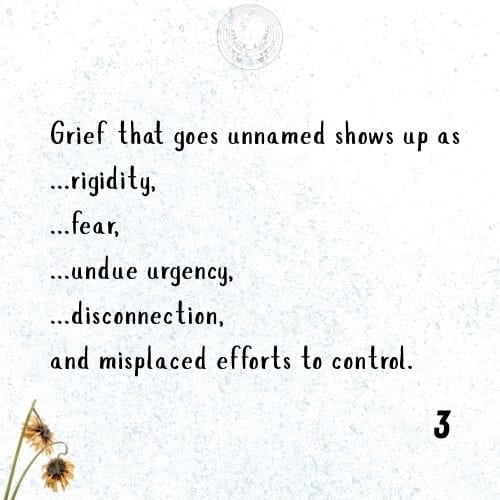
Without realizing it, many of us were already practicing a form of grief literacy, even if we did not yet have language for it.
This series exists to offer that language. It is an invitation to name what you have been carrying, to make sense of the emotional terrain you have been navigating, and to recognize grief not as a failure or downside of a self directed life, but as a companion within it.
I am writing this in a moment when grief is moving through the collective body in loud and relentless ways. We are watching cruelty become policy. We are witnessing violence carried out with bureaucratic efficiency. We are watching live footage of death being wielded as a form of power, and the pressure to harden, or to keep moving as if none of this is touching us runs oh so deep.
But remaining soft in a brutal world is an assertive and strategic practice. It is a skill that can be learned and relearned, supported by shared language and shaped in the presence of others who are willing to stay.
Unschooling taught many of us how to resist dehumanization. Grief teaches us how to stay human.
In the essays that follow, I’ll be exploring how the principles of self-directed education have shaped the way I tend grief in my own life and in my work.
I’ll write about trusting the process of loss the way we trust learning. I’ll write about consent and capacity. I’ll write about surrender and uncertainty. I’ll write about inheritance, liberation, and the stories we carry forward.
I’ll draw from my years of unschooling, from laying Fare of the Free Child to rest as an elder, from griefwerk, from community, and from walking alongside people who are learning how to live with what cannot be fixed.
This weekly series is a place for unschoolers to grieve out loud.
A place to bring the parts of this life that rarely make it into Instagram captions or conference talks. A place to honor what you’ve lost, what you’ve released, what you’ve outgrown, and what you’ve become.
If this series speaks to you, share it. Send it to the unschoolers who never talk about the hard parts. Send it to the parents who feel alone in their choices. Send it to the people who chose a different life and are quietly carrying the cost.


Member discussion