
Trusting Joy, Honoring Grief: The Quiet Work of a Healing Body
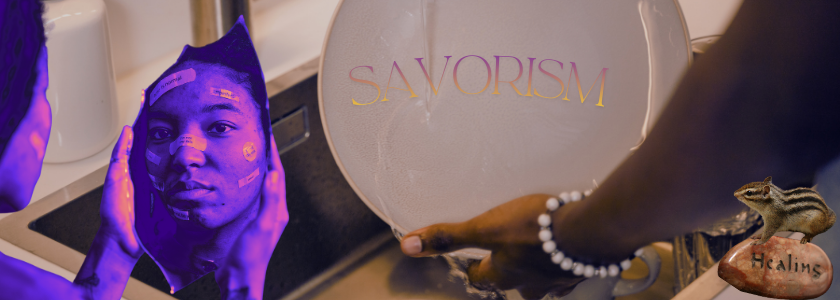
The house is so very still this morning. Not silent, still.
Still in the way that invites you to listen past the first layer of sound. The old wooden floors sigh under my footsteps, that familiar creak that became part of this home’s language. Outside, the birds are already chatting each other up through the trees, and a soft whisper of breeze is making its way through the spiced-toned leaves. When I look through the back door, a chipmunk is perched at the foot of the backyard umbrella stand, looking like it’s the team leader of the yard, surveying its space and probably fully aware that I’m staring at it.
I love catching moments like this because these tiny scenes that happen whether I witness them or not, slow me down and remind me of who I am now, who I’m becoming. A savorist, still and always. Someone who is learning how to let the small things touch me without needing to fix or frame them. Someone who has made a practice out of noticing, especially in the mornings when my body is still remembering that it/me/we is/are healing, but also remembering that I am alive.
I’m just over a month out from surgery--my seventh in this same part of my body, and the most intense one by far. The riskiest. The one that feels like it changed erthang on the inside. A new internal landscape. Rerouted. Recalibrated. A body I thought I knew becoming a stranger I’m learning again, slowly, gently, like a long-lost relative whose face I almost recognize.
This morning, standing here in this quiet house, I feel a kind of awe that I’m upright. That I’m walking around with ease. That I took a walk earlier, came home, hugged Kris, and watched the girls leave for their days. And then...this is the part that surprised me..I walked into the kitchen and saw the sink full of dishes…and smiled.
A hundred versions of me would not have smiled at that sink.
I’ve had all the conversations over the years, inside unschooling circles, in community spaces, with clients, with friends, about tasks and labor. About who carries what and why. About resentment and the gendered bullshit that haunts kitchens. About the communal agreements that feel sacred until someone forgets to follow them. I’ve felt every version of that frustration, every spike of “okay but why TF am I the one doing xyz again?”
But today didn’t hit that bruise at all.
Today, this body, this new, shifting, tender body, told me something different. Before I went to irritation or righteousness, I felt this wave of capacity wash over me. I felt the luxury of being able to do the dishes at all. The simple joy in moving my hands with purpose. The rhythm of rinsing, loading, washing the things that can’t go in the dishwasher. The simple pleasure of wiping down the counters before sweeping the floor, shaking out the mats, filling my favorite water bottle with apple cider vinegar, ginger, cinnamon, lemon, and water.
These li’l rituals felt like their own prayers, and each movement feels like an offering to the life I’m still learning to trust post-surgery. I was Ruby from the Max and Ruby cartoon—happy, humming, tending to the moment with ease. No resentment. No story. No perfect anything. Just joy.
And that joy made space for truth.
Because joy almost always opens the door for grief. It reminds us of who we were before this moment, and who we had to be to survive. Who we resented being, and who we shed along the way.
As I stood at the sink, hands warm from the water, I felt a soft grief rise for the version of me who was stretched thin in ways no one could fully see.
The me who was moving through perimenopause, riding the emotional, mental, and physical storms it carried. The me who was learning to first navigate, before she could appreciate this change of life stage. The me who looked at the same pile of dishes and saw failure or abandonment or proof that I was holding too much.
That version of me ain’t wrong. She ain’t dramatic. She ain’t ungrateful. She was carrying what she could with what she had, and what she understood.
But this version of me right here--the one in surgical menopause, the one walking differently through her days, the one freshly stitched back into herself--she needed this moment to honor her. To lay her down gently. To say thank you. To say I see you. To say you survived so I could savor.
And today, that’s the quiet curriculum of being a savorist. I'm learning how to notice the shift before the story. And learning how to stand at the sink, look at a pile of dishes, and ask: What newness is here today? What’s different in me right now?
Noticing how the same scene of dishes, crumbs, counter, floor, can feel brand new if you give it permission to. And maybe there’s something in that for you, too.
Maybe today, or whenever your next moment arrives, you can pause with something ordinary. Something you’ve done a ton of times. Something that usually irritates you or bores you or weighs you down. And before you reach for your well-worn reaction, you can engage madd question-askin, and ask yourself:
Is there another way this moment wants to meet me today?
Is there a softness or a shift I didn’t notice before?
Is there a joy tucked inside the edges of this thing I thought I already understood?
Because joy doesn’t erase grief, but joy is a wayfinder. As joy activist Thea Monyeè has reminded me time and time again, joy is a trustworthy reminder of the parts of us that still have room to breathe and to choose.
And when we acknowledge even a tiny spark of joy, it often points us directly toward the grief that’s ready to be tended, or released, or simply held with less resistance than before.
So I’m savoring all of it; the chipmunk homie, this newness of my healing body, dishes that didn’t piss me off today, and the oh-so-strange mercy of capacity returning. I’m savoring the tenderness of noticing myself in real time.
I hope wherever you are reading this, that you notice something today too. Even if it’s small. Even if it surprises you. Even if it breaks your heart a little on its way to letting something new live.
Member discussion